Skip to content
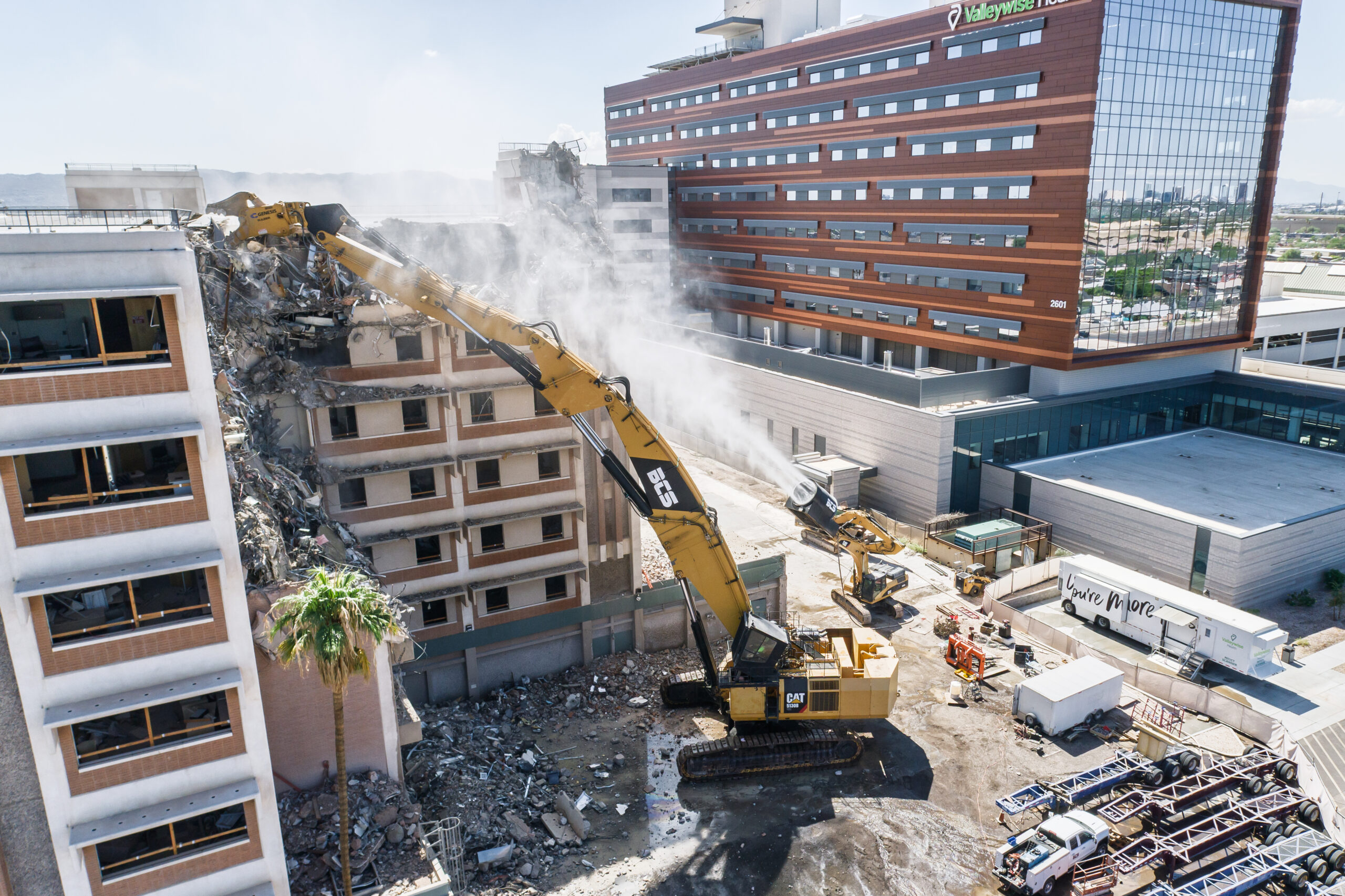
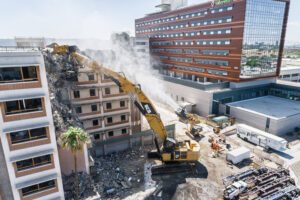
Six Opticom Tech cameras help operators and spotters see around a 400-ton excavator and monitor demolition work more than 150 feet from the cab.

“The CC04 continues operating without issue, even in the extreme Arizona summer heat. They are practically indestructible.”
– Cody Cole, Chief Design Officer, BCS Enterprises
Demolition work demands clear communication, careful coordination, and an accurate view of equipment and surrounding activity. Those needs become even more pronounced when the equipment is a 400-ton high-reach excavator working in tight spaces, with a demolition tool operating more than 150 feet from the cab.
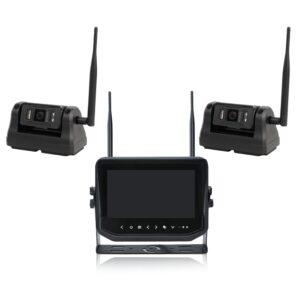
BCS Enterprises uses six Opticom Tech CC04 cameras to give the operator of its Cat 5130B UHD a live view around the machine and at the work tool. The camera feeds also help spotters understand what the operator sees from the cab while maintaining their own vantage points around the work area.
Problem
BCS acquired the Cat 5130B UHD in 2017 to expand its capabilities on large demolition projects. The machine began as a mining excavator before Rusch in the Netherlands heavily modified it for demolishing offshore platforms in Norway. Since acquiring it, BCS has made additional improvements to increase its vertical reach and stability.

The resulting machine is built for exceptionally demanding work. It can reach more than 150 feet while carrying a 25-ton tool, and BCS has used it to demolish power plants, hospitals, and other large structures in Arizona. Its base alone has a footprint of approximately 30 feet by 30 feet.
That scale creates a significant visibility challenge. The operator cannot see all sides of the excavator from the cab, particularly when helper machines are working nearby. The distance between the cab and the demolition tool can also make it difficult to see exactly what the tool is doing.

BCS relies on multiple spotters and constant radio communication to help the operator understand when to move and when to cut. However, the company also wanted to give the operator direct visual access to areas that would otherwise remain out of sight.
Partnership With Opticom
Cody Cole, Chief Design Officer at BCS, began looking for a camera system for the excavator in 2020. He tested several IP cameras, but the machine’s extreme operating conditions proved too demanding for them.
Most heavy-equipment camera systems Cole encountered used analog technology. BCS wanted a high-definition IP system that could show live video, record footage, and stream feeds remotely, but rugged IP camera options were difficult to find.
“I had a lot of requirements, and the CC04 checked all the boxes—vibration dampening, IP67, and high resolution in a compact form factor,” Cole said.
Implementation
BCS mounted six CC04 cameras on the Cat 5130B UHD. Four cameras surround the base to provide a 360-degree view around the excavator. Two additional cameras face the work tool to give the operator an up-close view of activity at the end of the machine’s high-reach boom.
Outdoor-rated Cat6 cables connect the cameras to a rugged NVR mounted in the cab and supply power over Ethernet (PoE).

BCS also fabricated a large in-cab bracket that holds the monitor on an adjustable track, allowing operators to position the display according to their preferences.

The operator primarily watches the feeds live, using the four perimeter views to check for obstructions and nearby equipment and the two tool views to monitor the demolition work. The NVR records the feeds so BCS can review footage when needed.
A 4G router extends that visibility beyond the cab. Spotters can access the camera feeds from an iPad so they can compare the operator’s view with what they see from their positions on the ground. This shared visual context supplements the team’s constant radio communication.
Results
The six-camera system gives the operator visual coverage that would not be possible from the cab alone. It supports awareness around the machine’s large base while also bringing the distant work tool into close view. For spotters, remote access to the same feeds provides a clearer understanding of the operator’s perspective as they guide the work from other vantage points.
The CC04 cameras have also withstood conditions that damaged the other IP cameras Cole tested. Demolition dust is a constant challenge, so BCS designed two custom attachments for Cat 330- and 345-class excavators that spray a fine water mist at speeds up to 75 mph. Cole said, “While the water is directed at the dust, the cameras mounted to the machine are subjected to conditions that can only be described as a tropical rainstorm throughout the workday.”
The cameras mounted near the demolition tool face tremendous vibration as well as Arizona’s summer heat. They also risk direct contact with falling or flying debris.

One incident put that durability to an unusual test. Demolition debris struck and broke the steel mount holding a CC04 camera, sending the camera more than 150 feet down onto a pile of steel.
“After recovering it, I was surprised to find that the camera still worked perfectly,” Cole said.
Conclusion
For BCS, the camera system has become part of how the team manages the unusual scale and visibility demands of high-reach demolition. The configuration combines live in-cab views, recorded footage and remote access for spotters without requiring the company to compromise on image quality or durability.
Cole also credits the ongoing relationship with Opticom Tech for helping BCS maintain a solution suited to its work. “Heidi is awesome. She always goes above and beyond to help me,” he said. “You can tell the team really does care. I have seen many improvements made to these cameras since 2020. It is apparent that Opticom listens to customer feedback.”